Expedition to the Future – Day 7: Where Atoms, Antimatter and Data Collide
What if you could stand inside a tunnel where antimatter is born, walk among the servers that store the secrets of the universe, and hear firsthand what the future of science might look like? Today, we did all that and more. From atoms to accelerators, from data to dark matter, our sixth day at CERN was a journey across scales and ideas — and every step reminded us just how far curiosity can take us.
Today was another unforgettable journey into the heart of CERN. We started our morning with a lecture by our host Mr. Zakezewski. It was a fascinating session that took us from the size of atoms to the speeds at which they’re accelerated—so fast that they pack as much energy as a train moving at 150 km per hour. It felt like peering behind the curtain of the universe itself.
Next, we visited the CERN Data Center. There, we learned how data from experiments is stored, processed, and visualized. A short presentation walked us through the incredible challenge of handling petabytes of data—like trying to bottle up an ocean of information. We were amazed by the hardware and servers that form the Tier 1 of CERN’s operations. Seeing the rows of blinking servers and hearing about the mind-boggling transfer rates was like stepping into the future.
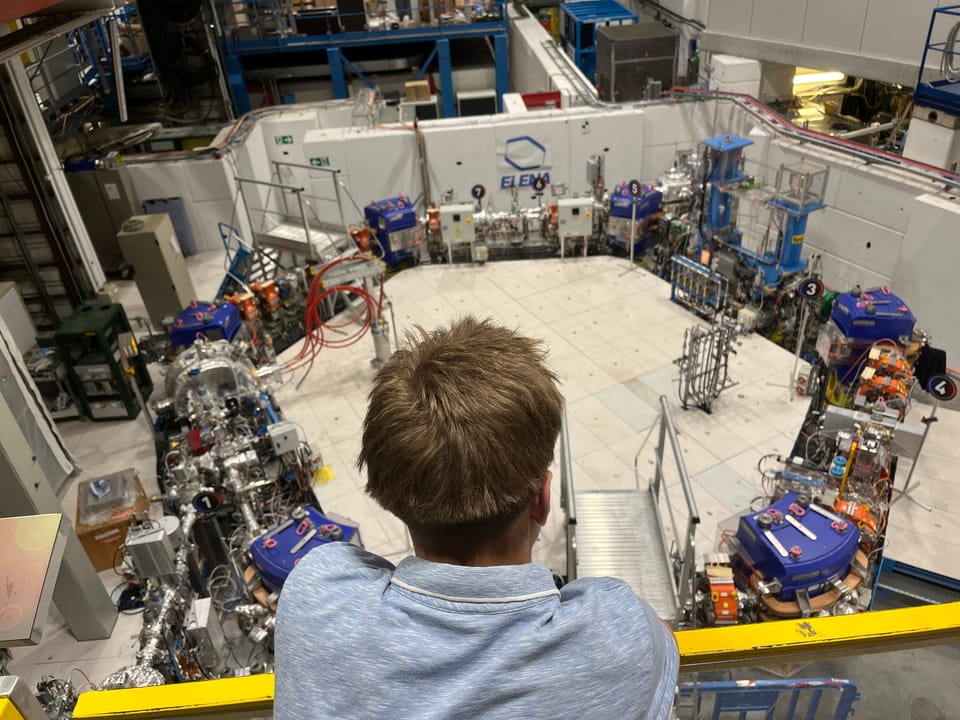
But the highlight of the day was still ahead: the Antimatter Decelerator (AD). We actually went inside—down into the collider’s tunnels, where beams of antimatter are born and studied. It felt almost otherworldly. We learned how antimatter is created, how it’s trapped, and why it’s so incredibly rare. One fact blew our minds: to produce a single gram of antimatter using the current setup would take as long as the entire age of the universe—13.8 billion years! Right now, CERN’s experiments are focused on making just a few atoms. It’s like watching humanity’s first steps on a journey into a whole new world.
The day ended with a final lecture on the future of CERN—about the proposed FCC collider, its incredible potential, and the challenges that still lie ahead. The conversation was filled with excitement and hope. Even as we took a group photo and shared our final questions, we knew this wasn’t truly the end—it was just another beginning.
As we said goodbye and share some local delicacies, we realized that every answer we got only pushed us to ask more. That’s the magic of science: it never stops. And neither do we.


